

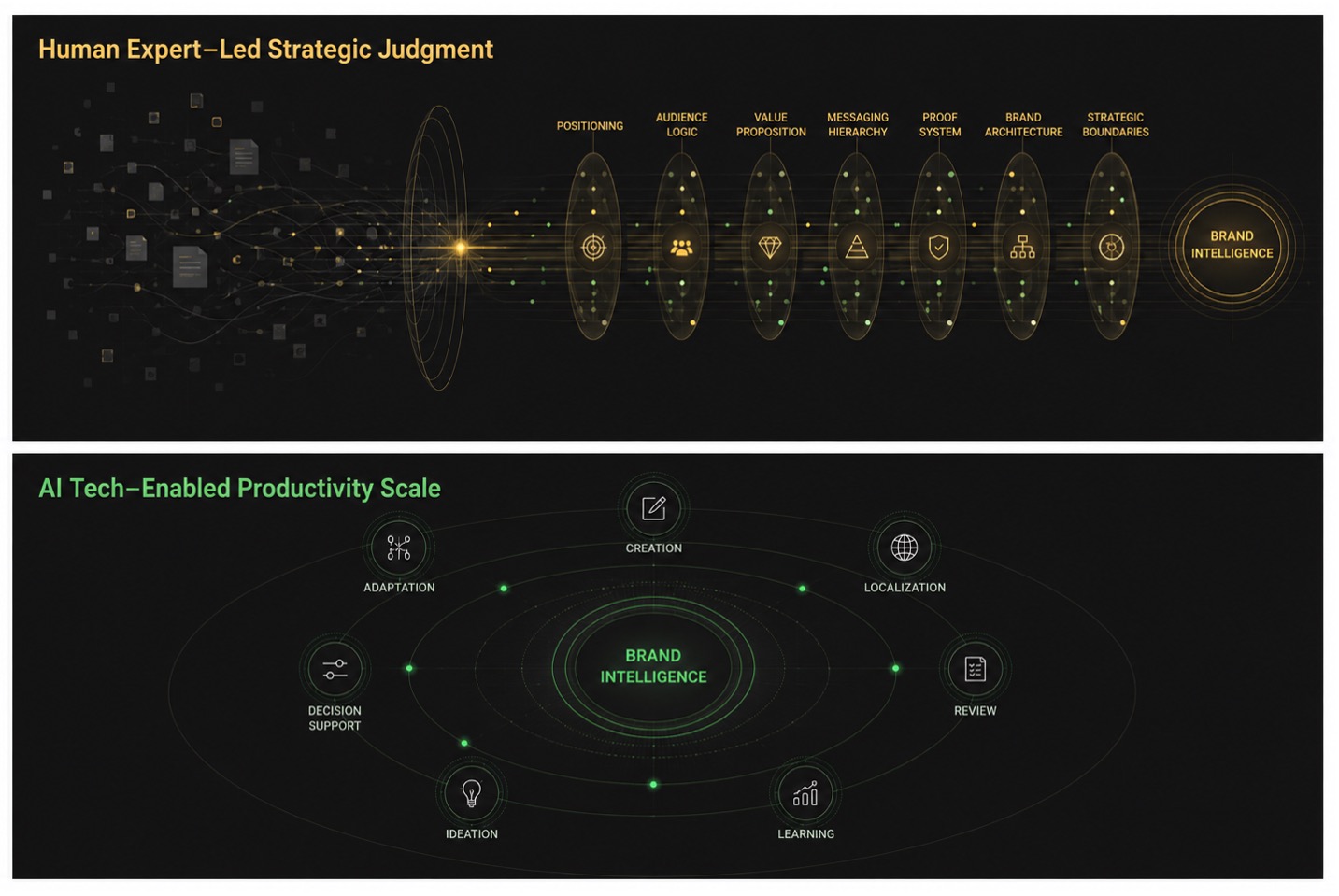
Brand Identity defines how a company understandsitself and how it should be understood by others. It connects business vision,brand positioning, value proposition, audience logic, brand architecture, andthe role a brand plays in growth.
For many companies, this identity is captured instrategy decks, brand books, messaging frameworks, visual systems, and internalguidelines. These assets are important. They help leadership align ondirection, help teams communicate with more coherence, and help agencies createwith a clearer sense of the brand.
But as AI becomes part of brand-related work, itcan no longer remain only as a strategic definition. It needs to become usableby the tools and workflows that increasingly participate in brand expression.
This is the shift from Brand Identity to BrandIntelligence.
Most companies do not lack brand materials. Theyoften have too many of them in different places. The problem is not simplystorage or access.
A searchable library does not automaticallycreate brand understanding.
AI can process these documents, but processingis not the same as understanding. If Brand Identity is treated as a collectionof files, AI may summarize content, extract keywords, or imitate language. Itmay still miss the strategic logic that gives the brand its meaning.
The task is therefore not to digitize brandassets. It is to structure the brand’s strategic logic.
Brand Intelligence is not a larger brand book.It is not a database of approved claims. It is not a prompt library.
It is a structured model of how the brand shouldbe understood, expressed, adapted, and evaluated.
At minimum, Brand Intelligence needs to connectseveral layers of brand strategy: the brand’s core belief and positioning, theaudience relationship it seeks to build, the value proposition it must makecredible, the proof points that support its claims, the brand architecture thatorganizes its offers, the messaging hierarchy that guides communication, andthe strategic boundaries that prevent dilution.
These elements cannot sit separately. They needto inform each other.
For example, a positioning statement shouldguide what kind of campaign idea is relevant. Audience logic should influencetone, message emphasis, and channel adaptation. Proof points should prevent AIfrom making vague or exaggerated claims. Brand architecture should clarifywhether a message belongs to the corporate brand, product brand, service line,or campaign layer. Strategic boundaries should help AI understand not only whatto say, but what not to simplify, overclaim, or imitate.
This is where Brand Identity becomesoperational.
A useful way to describe this structure is the BrandBrain.
The Brand Brain is not the “brain” of AI. It isthe brand’s own strategic intelligence, organized in a way that AI-assistedworkflows can use.
It translates Brand Identity into a workingmodel that can guide ideation, generation, localization, review, and learning.It does not replace expert strategy. It preserves and operationalizes it.
A strong Brand Brain does not only store whatthe brand says. It explains why the brand says it, to whom, under what context,and with what strategic intention.
This matters because AI output quality dependsheavily on the structure of the brand input. If the input is shallow, theoutput becomes generic. If the input is rigid, the output becomes repetitive.If the input is strategically structured, AI has a better chance of producingwork that is both consistent and adaptive.
AI needs to know how to choose between possibledirections. Should a message emphasize expertise, accessibility, innovation,trust, or cultural relevance? Should a creative idea stretch the brand into anew territory or reinforce existing recognition? Should localization preserveglobal consistency or adapt more strongly to local codes? Should a productclaim be elevated, softened, or supported with proof?
These are not merely contents generation choices.They are brand strategy choices.
Brand Intelligence helps make these choicesexplicit. It turns Brand Identity into a set of structured priorities,relationships, and boundaries that can guide action.
This shift changes the way of brand consulting.
That requires a different kind of consultingoutput: not only strategic recommendations, but structured brand intelligence;not only brand assets, but decision logic; not only guidelines, but systemsthat support creation, review, adaptation, and learning.
This is where human expertise and technologyintersect in a practical way. Human consultants define the strategic meaning ofthe brand. Technology helps apply that meaning across distributed workflows.BrandOS can be understood as one expression of this shift: a system that turns BrandIdentity into a Brand Brain, so AI-assisted tools can create, adapt, andevaluate brand work with stronger strategic grounding.
Brand Identity gives a brand its meaning. BrandIntelligence makes that meaning usable.


.svg)
Spreading ideas that valued.

Scan to Follow Labbrand on WeChat

.svg)