

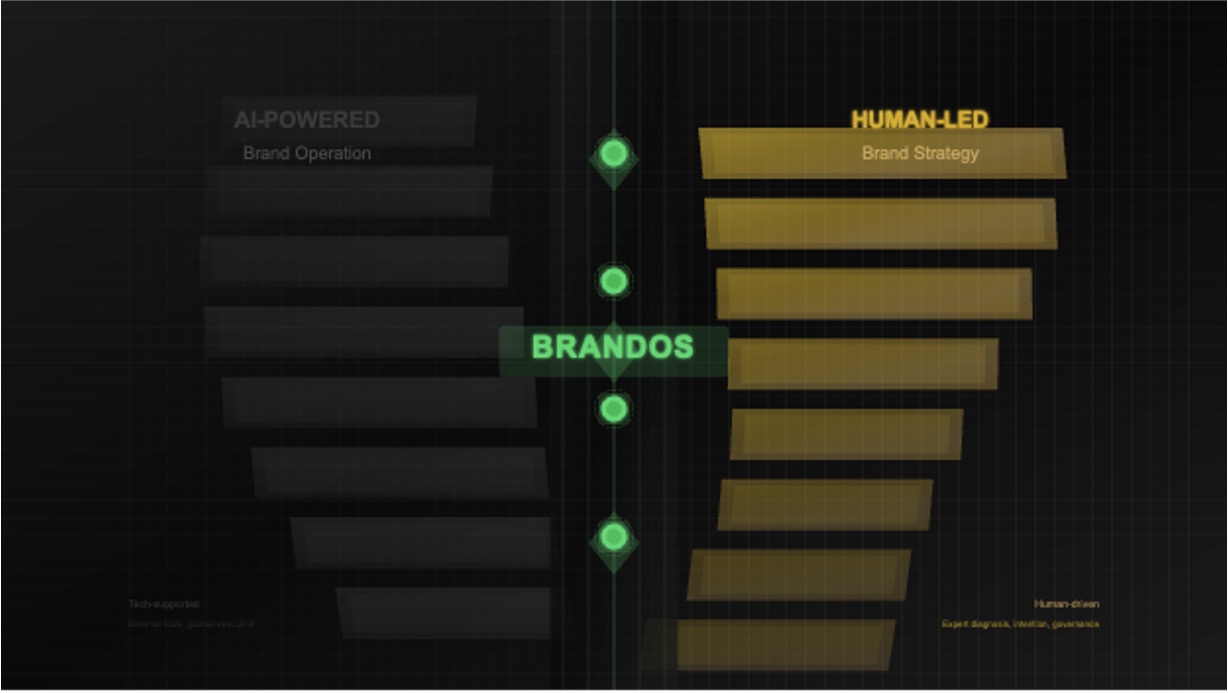
Most companies are now moving on two parallel tracks.
On one track, they continue to invest in brand upgrade: positioning, messaging systems, visual identity, brand architecture, customer experience principles, and brand governance. On the other, they are adopting AI platforms for content generation, design production, localization, campaign development, asset management, and marketing automation.
Both tracks are important. But they have not been connected well.
The missing layer between brand strategy and AI platforms is a translation layer.
Its role is to convert expert-defined brand strategy into AI-operable logic.
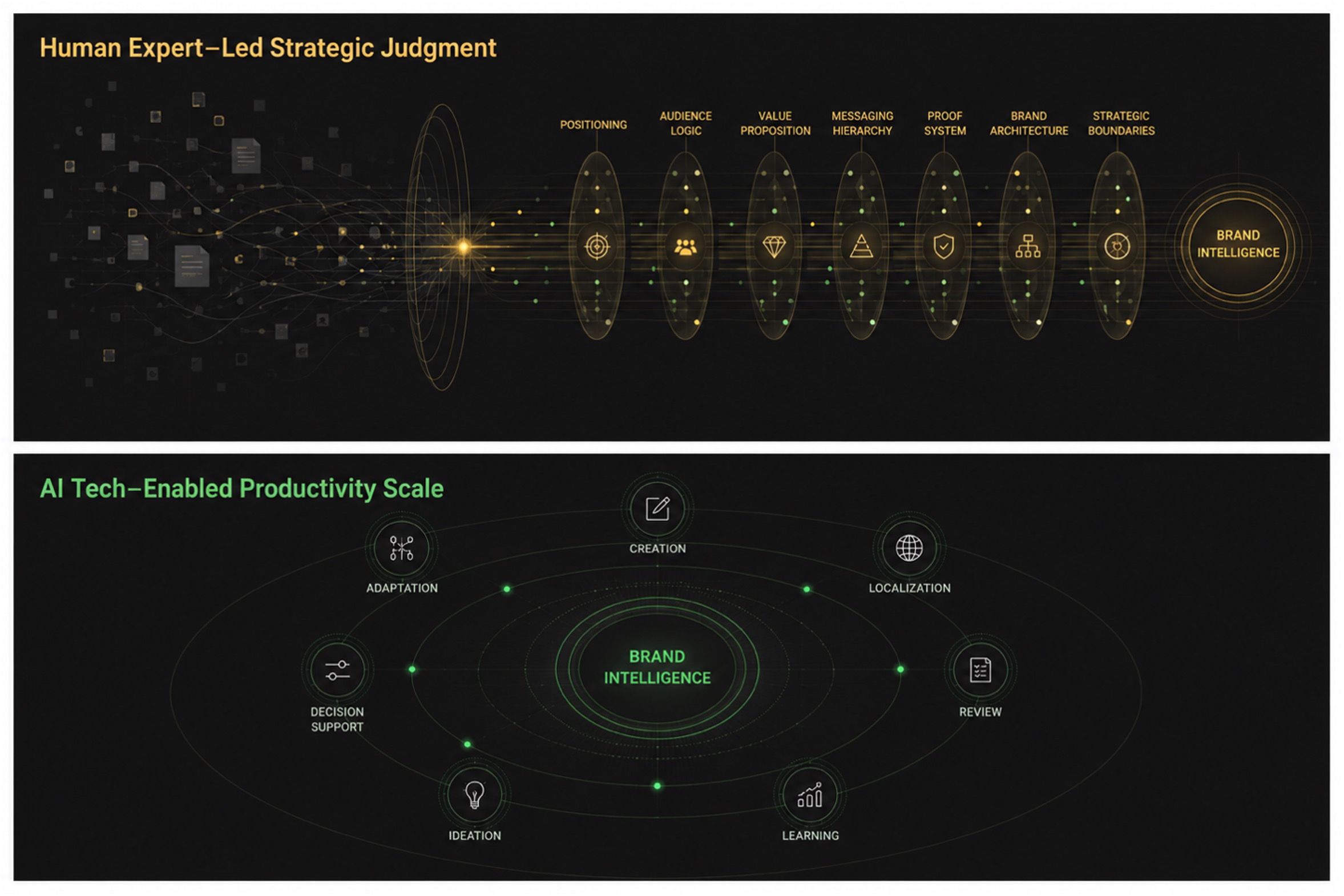
This layer should not replace existing AI platforms. It should guide them. It should clarify what the brand stands for, what the current brand intention is, what the AI should protect, what it can adapt, what counts as brand-building, and what should be flagged as risk.
In practice, this layer may include several types of outputs.
It can provide a structured Brand Brain that captures positioning, audience logic, messaging hierarchy, proof points, brand architecture, and strategic boundaries. It can define governance criteria that evaluate whether outputs support Brand Power intentions. It can create creative briefs, and ideation prompts that guide AI generation. It can provide review rubrics that assess strategic fit, audience resonance, creative vitality, and expression consistency. It can package brand intelligence for use in external platforms.
The point is not to build another isolated tool. The point is to make existing tools more brand-aware.
BrandOS can be understood as one expression of this missing layer.
It is not positioned as another generic AI content generator. Its role is to act as a Brand AI Operation Gateway: a system that turns brand strategy into AI-operable brand intelligence, and then connects that intelligence to creation, review, feedback, and external platform workflows.
This matters because companies are unlikely to rely on a single AI platform. Teams may use different tools for writing, design, localization, asset management, campaign planning, and internal communication. Without a shared brand intelligence layer, each tool may interpret the brand differently.
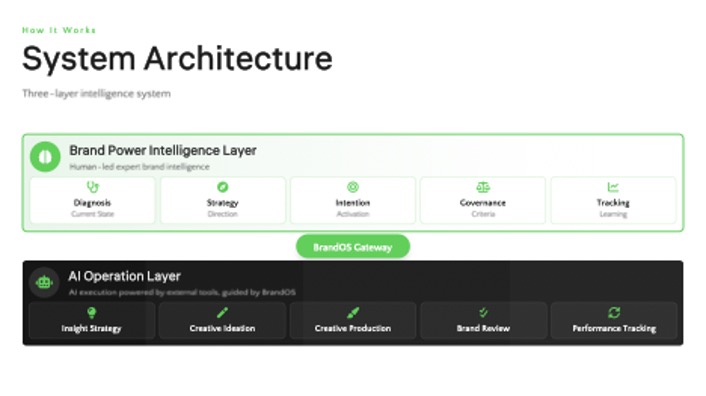
BrandOS addresses this by creating a structured source of brand logic that can travel across workflows. It can help AI tools understand not only the brand’s language and visual rules, but also its strategic intention, governance criteria, creative boundaries, and review standards.
In this sense, BrandOS does not compete with platforms such as AI content tools, design systems, DAM platforms, or MarTech solutions. It complements them by providing the brand intelligence they need to execute with strategic coherence.
A strategy deck is no longer enough if the daily execution environment is increasingly AI-assisted.
The value of brand consultants has traditionally been concentrated in diagnosis, strategy, identity creation, and communication and experience design. These remain essential. But AI changes the form in which this value must be delivered.
Brand strategy and AI platforms should not sit on separate tracks. Strategy needs to become operable. Platforms need to become brand-aware. Between the two, companies need a layer that translates brand judgment into AI action. This is where human-and-technology consulting becomes practical.


.svg)
Spreading ideas that valued.

Scan to Follow Labbrand on WeChat

.svg)