


Companies are increasingly using AI in brand-facing work: drafting social posts, localizing campaign messages, generating product descriptions, preparing sales materials, supporting customer communication, and developing creative prompts.
These applications are often introduced as productivity tools. They help teams move faster and produce more options. But once AI enters brand-facing tasks, it is no longer only assisting production. It is participating in brand expression.
A brand is not shaped only by major campaigns or official statements. It is also shaped by everyday touchpoints: a sales deck, a recruitment post, a localized webpage, a conference script, a customer response, or a product explanation. When AI contributes to these outputs, it becomes part of how enterprise brand is represented.
This raises a management question that many companies have not fully addressed: can AI accurately represent the brand it is speaking for?
Brand representation has traditionally been managed through brand strategy, brand positioning, verbal identity, visual identity, brand experience principles, and approval processes. These systems remain necessary, but they were designed mainly for human interpretation.
A brand manager or agency partner does not simply apply rules. They interpret strategic intent. They understand the link between brand positioning and audience relevance. They know when a message should adapt to a market, when a claim needs proof, and when a creative idea stretches the brand productively rather than diluting it.
AI does not naturally hold this judgment.
Many companies worry that AI will produce off-brand content: wrong tone, incorrect claims, poor quality, or inconsistent visuals. These risks are real, but they are also relatively easy to detect.
The more important risk is strategic brand drift.
Brand drift happens when repeated outputs gradually move the brand away from its intended meaning and strategic objective. Each output may be acceptable on its own. At scale, the effect becomes material.
For brand-led organizations, the question is therefore not only whether AI output is correct. It is whether the output contributes to Brand Power: whether it reinforces the intended positioning, builds the right audience relationship, supports the desired perception shift, and protects the brand core while allowing creative variation.
These are brand strategy questions, not content production questions.
Most enterprises already have brand assets. These assets remain valuable, but they were not designed for AI-assisted execution.
A guideline can tell people how a brand should look and sound. It does not necessarily tell AI how to prioritize strategic intent, separate non-negotiable principles from flexible expressions, or judge whether an output is merely compliant or genuinely brand-building.
This is the required shift: from documented identity to operational identity.
A documented identity explains the brand to people. An operational identity helps people and tools make brand-related decisions across content generation, creative ideation, localization, review, and learning. The goal is not to automate brand judgment, but to make expert brand judgment usable inside AI-assisted workflows.
AI does not reduce the need for brand expertise. It changes where that expertise is applied.
In a slower production model, brand experts could review key outputs directly. As AI increases the volume and speed of brand-related production, this model becomes harder to sustain. Experts cannot manually police every draft, prompt, visual direction, local adaptation, and internal communication.
Their role needs to move upstream: defining brand intention, governance criteria, creative boundaries, off-brand risks, and feedback mechanisms.
A modern enterprise brand system should not only define what the brand is. It should help every tool, team, and partner understand how the brand should be represented.
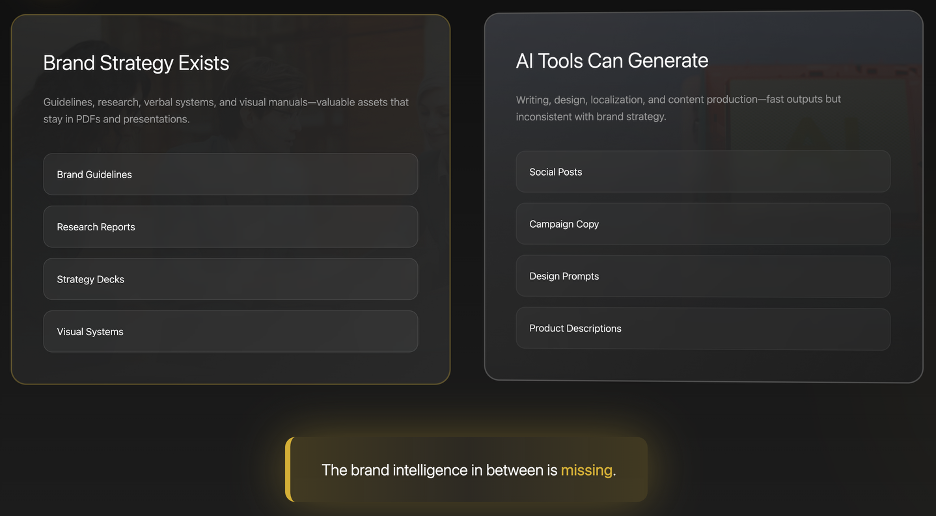
This shift points to a new consulting discipline: translating enterprise brands into AI-operable brand intelligence. The value is not content automation, but strategic control over how AI represents a brand across creation, localization, review, and learning.

Human expertise defines brand intention, governance criteria, and the boundaries of creative adaptation; technology scales their application through workflows, prompts, rubrics, and feedback loops.
AI BrandOS is one expression of this approach. It demonstrates how a human-and-technology consultancy can embed strategic judgment into the systems that increasingly speak, create, and act on behalf of brands — with accountability, consistency, and strategic coherence across organization, markets and platforms.


.svg)
Spreading ideas that valued.

Scan to Follow Labbrand on WeChat

.svg)